放牛班的春天
Short drama productions, AI are bringing new life to rural Chinese villages_我的网站

一 |
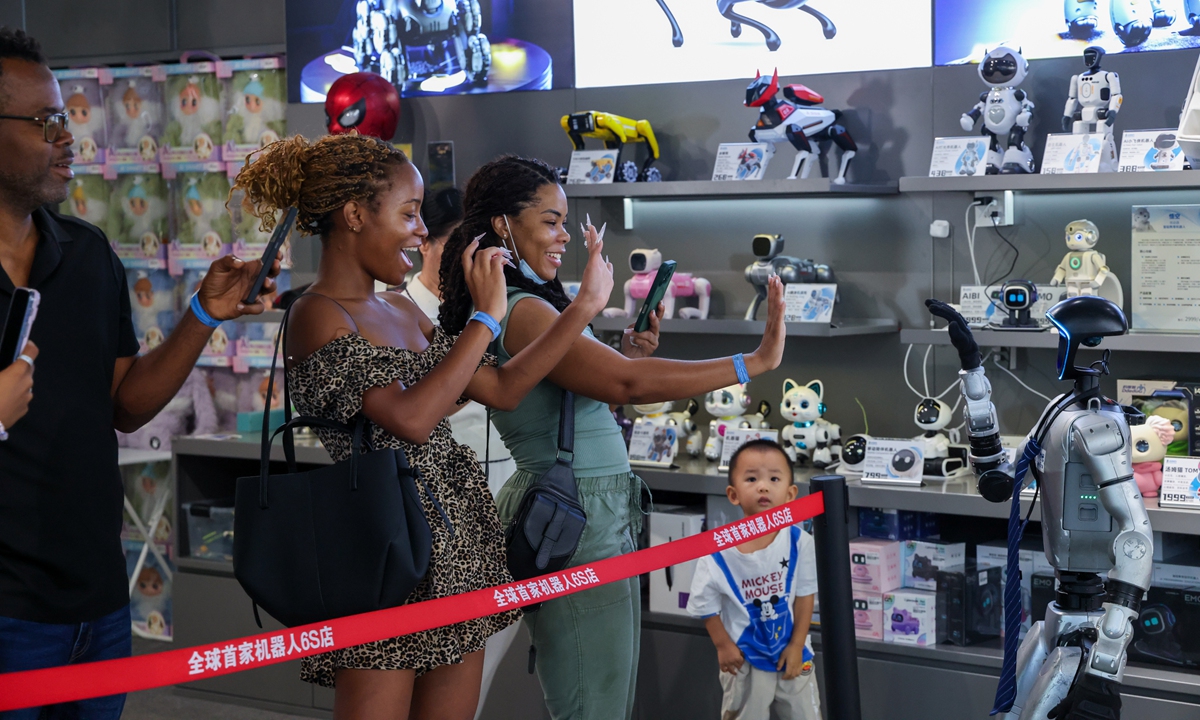
Photo released on August 9, 2026 shows tourists from Jamaica interacting with a humanoid robot at the world's first robot 6S store in Longgang District, Shenzhen, South China's Guangdong Province, on August 4. Photo: XinhuaChina's cutting-edge industrial upgrade witnessed two major landmarks on Monday, marking the country's full-fledged global lead in humanoid robotics and further solidifying the rise of its "new new three" strategic sectors — robotics, artificial intelligence and innovative medicine.
Industry data showed that Chinese vendors accounted for more than 97 percent of global humanoid robot shipments in the first half of 2026. Additionally, Chinese robotics firm Unitree Robotics began its share subscription process for its listing on Shanghai's stock market, becoming the first humanoid robot A-share stock.
The global humanoid robot shipments reached approximately 19,100 units in the first half of the year, surging 272 percent year-on-year. The market saw a leadership shift, with Chinese robotic company AGIBOT overtaking Unitree to become the world's largest humanoid robot vendor. China also represented more than 85 percent of global demand, according to the latest research from Smart Analytics Global (SAG).
As the former global leader in 2025 with annual shipments of 5,500 units, Unitree Robotics set its IPO offering price at 150.8 yuan ($22.35) per share on Monday. The initial public offering (IPO) is expected to raise 6.1 billion yuan, meaning an estimated market capitalization of around 61 billion yuan, according to media reports. The final online subscription winning rate will be 0.0181 percent, Unitree said on Monday.
The breakthroughs in humanoid robotics represent the latest landmark of China's booming "new new three" industries, which are emerging as core pillars driving the country's high-end manufacturing upgrade, export expansion and future economic growth.
Driving forces The rapid and comprehensive rise of China's robotic sector stems not merely from policy incentives, but from integrated advantages in complete manufacturing chains, forward-looking institutional arrangements and massive real-world application scenarios, industry analysts noted.
"The answer lies not in mere policy slogans, but in the synergies rooted in its manufacturing base, early institutional frameworks, and vast application scenarios. These factors have driven the 'new new three' industries onto the global stage," Zhang Xiaorong, director of the Beijing-based Cutting-Edge Technology Research Institute, told the Global Times on Monday.
A robust supply chain has been decisive. The localization rates across China's robot industry chain have risen markedly in 2026, with core components shifting to domestic control, CCTV News reported, citing an executive of a Shenzhen-based robot company, who said that more than 90 percent of key parts for its humanoid robots are sourced domestically.
"No other market is better suited for the robotic industry than China," the executive said.
Institutional analysis noted that the domestic production rate of Unitree Robotics' supply chain reaches 90 percent, while all core components are fully self-developed.
Zhang also said the large domestic market serves as a unique testing ground.
"Strong robot exports reflect advances in complete machine design, system integration, scenario algorithms, rapid delivery, and cost control, alongside continued localization of reducers, servo systems, and sensors. Large-scale applications in new energy vehicles, electronics manufacturing, and warehousing provide frequent iteration and engineering validation," said Zhang.
Institutional foresight also played a role. Robot manufacturing was first listed as an independent industry in the national standard for industry classification in October 2017, with sub-categories including "industrial robot manufacturing" and "special operation robot manufacturing" following in 2023.
Analysts noted that this early classification facilitated later policy support, capital-market positioning, and statistical monitoring.
In June 2026, several ministries launched a special program for real-scenario training of humanoid robots and embodied AI.
Customs adjustments, effective from January 1, added specific tariff codes for intelligent biomimetic and cleaning robots, simplifying export clearance.
Insurance coverage also followed. In June, China Export & Credit Insurance Corp issued an insurance policy for AGIBOT's embodied robot export project, providing overseas risk coverage.
Supported by complete industrial chains, rich scenarios and systematic policy guarantees, China's robotic sector has built an unshakable global edge, experts noted.
A faster paceOfficial data showed that China has more than 400 complete humanoid robot models - over half the global total - while quadruped robots account for nearly 70 percent of worldwide sales.
"China may produce more than 100,000 humanoid robots this year, with even higher growth expected in the following years, pointing to long-term opportunities in a sector with deep potential," Yang Delong, chief economist at Shenzhen-based First Seafront Fund, told the Global Times on Monday.
China's robot export momentum has also reached new heights. After becoming a net exporter of industrial robots for the first time in 2025, China's industrial robot exports reached 6.29 billion yuan in the first half of 2026, reaching 141 countries and regions, official statistics show. Surgical robot exports rose 3.3 times year-on-year. Overall robot exports grew 359 percent.
AGIBOT, the champion of humanoid robot shipment so far this year, illustrated the rapid scaling: Its 15,000th embodied AI robot rolled off the line on June 28, less than three months after the 10,000-unit milestone.
All units are being delivered to domestic and overseas customers for use in 3C (computer, communication and consumer electronics) manufacturing, warehousing and logistics, and commercial services, AGIBOT told the Global Times.
Jiang Qingsong, company partner and co-president of AGIBOT, told the Global Times on Monday that the company aims for overseas sales to exceed 30 percent of its total in 2026 and potentially surpass 50 percent later.
Strong progress in robotics is closely backed by China's booming artificial intelligence sector.
Hugging Face's latest report found that over the past year, "Chinese models quickly accounted for the plurality or 41 percent of downloads," surpassing the US for the first time.
On the OpenRouter platform, Chinese AI models' token usage reached 34.25 trillion in the week ended Sunday, meaning roughly half of global share, while remaining ahead of US models for the 15th consecutive week.
Yang noted that China's AI progress is supporting growth across six frontier sectors - robotics, semiconductors, computing power and algorithms, commercial spaceflight, solid-state batteries, and biomedicine.
In terms of innovative drugs, by the end of 2025, China had 4,751 innovative drugs in development - 33.7 percent of the world total - making it the global leader in the pipeline.
Outbound licensing deals totaled about $110 billion in the first half of 2026 - already 80 percent of the full-year 2025 figure - with Chinese firms occupying eight of the global top 10 pharma deals. During the same period, 38 innovative drugs were approved, according to data from National Medical Products Administration.
Benefit the worldThe vigorous rise of the "new new three" industries marks China's third major upgrade in export structure, following the traditional "old three" (garments, furniture and home appliances) and the "new three" (new energy vehicles, lithium-ion batteries and photovoltaics). Each industrial iteration features higher technological content, stronger innovation capacity and deeper integration into the global economy.
China's breakthroughs in robotics, AI and innovative medicine deliver tangible benefits to global industries and consumers.
For example, AGIBOT's European representative Sandy Liu told the Global Times that universities and large manufacturers in automotive and warehousing are the company's main users in Europe, driven by rising labor costs and the need for new solutions.
Chinese open-source AI models have transformed high-end artificial intelligence technology from exclusive luxury resources into affordable, accessible digital infrastructure, benefiting global startups and developing economies. Innovative drug outbound licensing also accelerates global research collaboration and improves global patient access to cutting-edge treatments, analysts pointed out.
China's role in global trade is shifting from single manufacturing links toward a deeper embedding in technology, systems, and standards. What remains constant is the innovation that injects valuable certainty into the world economy and supports more inclusive globalization, analysts noted.
。
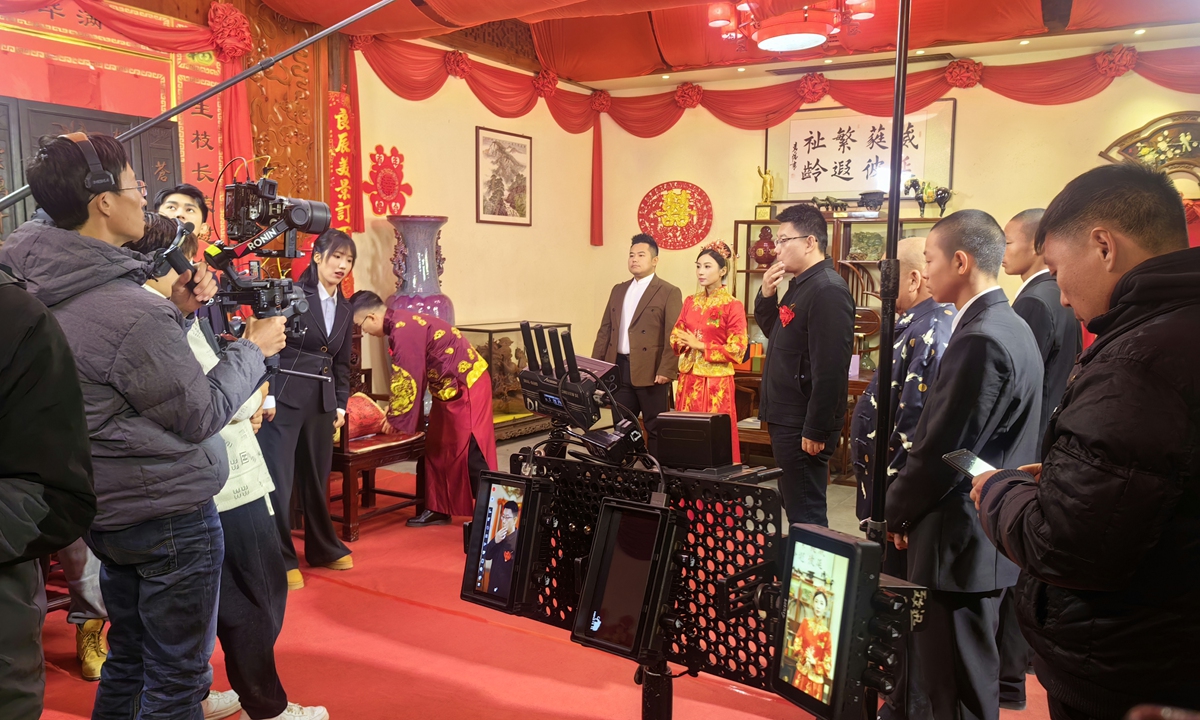
A short drama crew films a wedding-themed scene at a traditional residence in Yuanqiao village. Photo: Courtesy of Yuanqiao village
Yang Ni, a villager from Yuanqiao in Dengfeng, Central China's Henan Province, still remembers the nervous excitement of facing a slowly advancing camera for the first time. Now, she shifts with ease between roles, from a maidservant trailing a heroine in a historical drama to a famine-struck villager before the People's Republic of China was set up in 1949.
Experiencing so many lives within various screenplays, Yang said that short dramas have transformed not only her life, but also the ancient village she calls home.
Yuanqiao, a small village with a history that traces back over 600 years, has welcomed more than 70 short drama crews in recent years. The creators have captured every angle of the village's traditional courtyards, winding alleys, and gently rising cooking smoke. Locals have grown used to exchanging their daily farm clothes for costumes between busy seasons, giving life to lively townsfolk on vertical screens.
Yuanqiao village's revitalization is not just a story told through the camera lens. Si Jianbin, responsible for short drama coordination in the village, told the Global Times that the changes brought by short drama filming are visible in many ways.
With traditional buildings serving as natural film sets, once-abandoned houses, crumbling village walls, and old opera stages have been repaired and preserved. This has renewed villagers' sense of cultural stewardship. The arrival of drama crews has also broadened job opportunities for local youth; more young people are now choosing to stay or return home, breathing new life into the village.
Si noted that challenges also persist. The swift rise of AI-generated dramas is reducing demand for real-life shoots, and the number of visiting productions in the village has started to drop. Still, Si remains confident, noting that the village's authentic architecture meets the growing demand for high-quality short dramas. He said that leveraging this unique match will secure a promising future for revitalizing rural areas through film.
Changed villages
"For years, I only saw our old houses as broken-down obstacles; after filming, I realized every brick and tile is our cultural heritage," Yang said. Having played a background actor in numerous dramas - from period pieces to modern stories - she and her neighbors now see their ancient city walls, opera stages, temples, and homes through new eyes.
Some once-vacant houses have found new purpose as meticulously arranged sets, bearing witness to love stories or family feasts. One courtyard, frequently appearing in short dramas, is adorned with red lanterns and paper cuttings to express joy. Villagers redecorate it for shoots, blending cheerful ambiance with authentic period feel.
Today, Yuanqiao's residents - all from toddlers to seniors, even family donkeys and dogs - have become "stars" on camera. People farm during the busy season, then slip into costumes to perform, seamlessly shifting between fields and film sets.
Younger villagers have found new skills and work too. Si noted that more than half of local youth have acted as extras, with some job-seeking college graduates now learning editing and computer skills from the drama teams, opening the door to steady work in short film production.
The economic benefits for the village are clear. Si pointed out that village income grew from 4 million yuan ($593,330) in 2024 to over 5 million in 2025, a 20 percent of increase thanks to short drama filming. Most villagers have seen their annual incomes rise by around 5,000 yuan as a result.
Traditional crafts once on the verge of disappearing - such as paper-cutting and basket-weaving - are also reviving. Villager An Qing'e, known for her hand-woven flower baskets, was discovered by a filming crew and soon found online customers for her props.
Tourists, too, are seeing the village in a new light, as site visiting becomes an immersive experience. They are no longer fleeting passersby, but participants in the living stories of the ancient village.
The sets created for filming repurpose historical spaces, allowing visitors to step into the joys and sorrows of different eras.
This phenomenon is not limited to Yuanqiao village. The unique needs of rural and historical short dramas perfectly match the spaces and cultural resources of China's villages. Other places, such as Hujiaxi in Yuanling county, Central China's Hunan Province, and Nanhu in Jinyun county, East China's Zhejiang Province, are attracting drama crews and experimenting with a rural revitalization approach combining short drama with agricultural and cultural tourism.
Seeking the irreplaceableStill, the path for rural short dramas is being tested by the realities of the market.
The rise of AI-generated content is quickly diverting orders away from real-location shoots. Si said that after peaking at 35 crews in 2025, the number shrank to one or two per month in Yuanqiao village by 2026.
Even so, Si sees a hopeful future. While AI short dramas win on low-cost virtual settings, China continues to encourage the creation of well-crafted real-life dramas through supportive policies.
There is a lasting appeal in the atmosphere, sense of history, and human vitality that only real villages can provide - qualities virtual images cannot match. As audiences and studios increasingly seek authenticity and quality sets, villages like Yuanqiao have lasting room to grow.
Zhang Peng, a cultural researcher and associate professor at Nanjing Normal University, told the Global Times that the rise of AI-generated short dramas is reshaping the industry. However, this does not mean villages will lose out on the benefits brought by filming. On the contrary, when the bubble fades, truly valuable villages may be in even greater demand.
Their core competitiveness is not just cheaper venues, Zhang explained, but their unique local culture, authentic lifestyle, and the fusion of online and offline tourism experiences.
"To keep these benefits, villages should not compete with AI on cost and efficiency," Zhang noted. "Instead, they must redefine their own irreplaceability in the production chain."
Ding Daoshi, a veteran internet analyst, offers a word of caution: short dramas change fast, and their impact rarely lasts as long as movies or TV series. For villages, the key to sustainable development is leaning on their unique heritage and not just short dramas.
By finding their own irreplaceable assets and combining them with the energy of film, they can secure their future for the long haul.
。
Current article:http://pxcfq9d.ruwentaqintiaozhupapaigai.shop/fs5vp/20260826/703753.html
Published on:19:05:11

 WhatsApp Will Allow Users to Limit Visibility of Their Online Status, Leave Groups Unnoticed
 施罗德:2023世界杯夺冠之后 我的生涯再无遗憾
 Sambhal Violence Report : संभल में मिले हरिहर मंदिर के सबूत, संभल हिंसा जांच समिति ने मुख्यमंत्री को सौंपी रिपोर्ट
 AI带货须亮明“身份”
 给近三年最好的10部年代剧排个名:《人世间》第6,第1名没有争议
 新华社消息丨前7个月我国工业机器人产量同比增长28.5%
 臻宝科技:上半年净利润1.07亿元,同比增长25.74%
 《精准营养技术与产业创新白皮书》发布,林旭:精准营养产业发展离不开产学研深度协同


